At the Kep crab market you buy live crab by the kilo from the sellers on the waterfront, then pay a stall a small fee to cook it, or you sit down at one of the restaurants beside the market and order from a menu. Either way, agree the complete price, cooking included, before anything goes in the wok. In 2026, budget around $20–30 for two for a kilo of crab plus shrimp or squid, rice and drinks. The dish to order is crab fried with fresh green Kampot pepper.
On this page
How the market works
In Khmer it's Psar Kdam, simply "crab market": a row of seafood stalls, cooks and restaurants on the waterfront at Kep. The crabs are kept alive in cane baskets sunk in the shallows just offshore. When you buy, a seller often wades out, pulls up a basket and carries it back to the dock so you can choose. Many of the sellers are women. Besides crab you'll find shrimp, squid and fish, and women selling cooked rice.
There are two ways to eat here:
| Market stalls (do it yourself) | Restaurant beside the market | |
|---|---|---|
| How it works | Buy crab from a seller, take it to a cook, eat at a drinks stall's table | Sit down, choose from a menu, the restaurant handles everything |
| Price | Usually cheaper, but you negotiate each step | Usually higher; you order from a menu |
| Best for | Curious eaters who enjoy the bustle | Families, first-timers, anyone who'd rather not haggle |
Neither is "the real one". It just depends on how much bustle and bargaining you want with your lunch.
Buying at the stalls, step by step
- Walk the market first. Look at a few sellers, see what's fresh and ask a couple of prices before you commit.
- Ask the price per kilo, and check whether a quote is per kilo, per crab or per portion.
- Pick your crabs. Sellers expect you to choose; locals reach into the basket themselves. Ask for kdam thom, big crabs, which are easier to eat.
- Watch the weighing, and agree the final price for what's on the scale.
- Agree the cooking. A cook charges a small fee per kilo, a little more to stir-fry than to boil. Ask before you hand the crabs over.
- Add rice and drinks. If you sit at a drinks stall's table, buy your drinks there.
- Confirm the total for everything before cooking starts. Bring cash in small notes.
About bargaining: the first price isn't always the going rate, but the gap is usually small, often a dollar or two per kilo. Keep it friendly and smile. A Khmer word helps: t'lay na! means "so expensive!". If you don't want to haggle at all, a restaurant is the easier choice.
What does crab cost?
Prices change with the catch, the season and demand, so treat old blog figures as history, not a quote.
| Item | Guide price | Source and date |
|---|---|---|
| Meal for two: 1 kg crab, shrimp or squid, rice, drinks | About $20–30 | Travel guide, 2026 |
| Live crab per kilo | Around $10 per kilo has been quoted; smaller crabs less | Guidebook, undated |
| Cooking at a stall | A small fee per kilo, more to fry than to boil | Long-standing practice; ask on the day |
| Holidays | Prices can rise sharply | Reported around Chinese New Year |
For context, a 2014 report put large crabs at about $6–7.50 a kilo, with boiling at about $0.75 and stir-frying about $1.25 per kilo. Expect more than that in 2026.
What to order
- Crab with green Kampot pepper (kdam chaa mrech kchei). Crab stir-fried with whole sprigs of fresh green peppercorns from the farms just inland. This is the one Kep is famous for.
- Boiled or steamed crab, with a dip of lime juice, salt and Kampot pepper. Simple, and lets you taste the crab.
- Shrimp and squid, grilled or fried, to round out the table.
- Rice, and a cold drink or fresh sugar-cane juice.
Male or female? Female crabs carry roe and have a wider, darker "apron" underneath. Cambodians often prize them, so they can cost more. Males can have meatier claws and may be cheaper. If you're not keen on roe, ask for males.
A kilo of crab is about right for two people alongside other dishes. Crab is messy work, so expect to use your hands. For everything else worth eating on this coast, see our Kampot and Kep food guide.
When to go
- Lunch is the main sitting and the liveliest time. The sellers deal in that day's catch.
- Opening hours aren't posted. If you're thinking of an evening visit, check locally first.
- Weekends and public holidays tend to be busier, with visitors from Phnom Penh. Prices can climb at Chinese New Year and other big holidays.
- Weather: in the rainy season (roughly May to October) afternoon showers are common, so lunch is the safer slot.
Getting there from Kampot
Kep is about 25 km from Kampot, 35–45 minutes by tuk-tuk on a flat road. Most people make a day of it, with the salt fields, La Plantation or Secret Lake on the way. Our Kampot to Kep by tuk-tuk guide covers times, fares and a full-day plan.
What's nearby
- Kep Beach. The town's main beach, widened with white sand brought in from Sihanoukville. Fine for a paddle and a walk after lunch.
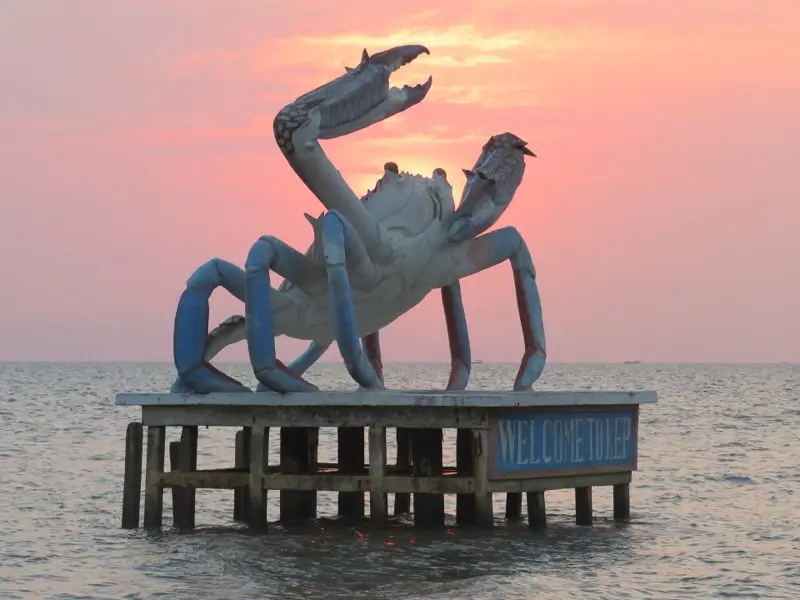
- The Giant Crab statue. A big crab sculpture standing in the sea just off the shore near Kep Beach, a popular photo spot, especially near sunset.
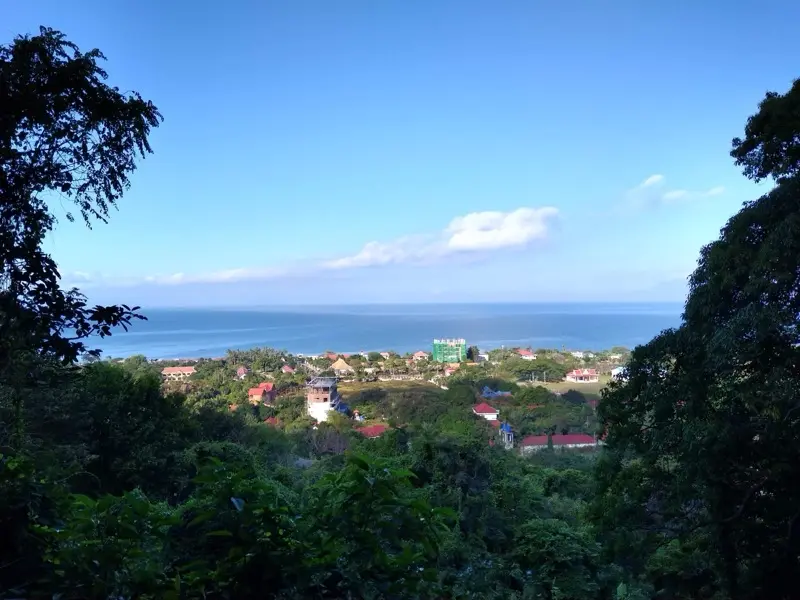
- Kep National Park. An 8 km loop around the Kep hills, starting behind Veranda Natural Resort. Most of the main track is now a concrete path; a steeper side trail, the "Stairway to Heaven", climbs past a small pagoda to Sunset Rock. Foreigners pay about $1 (4,000 riel) at the entrance or to a ranger on the trail. A short section is enough after a big lunch.
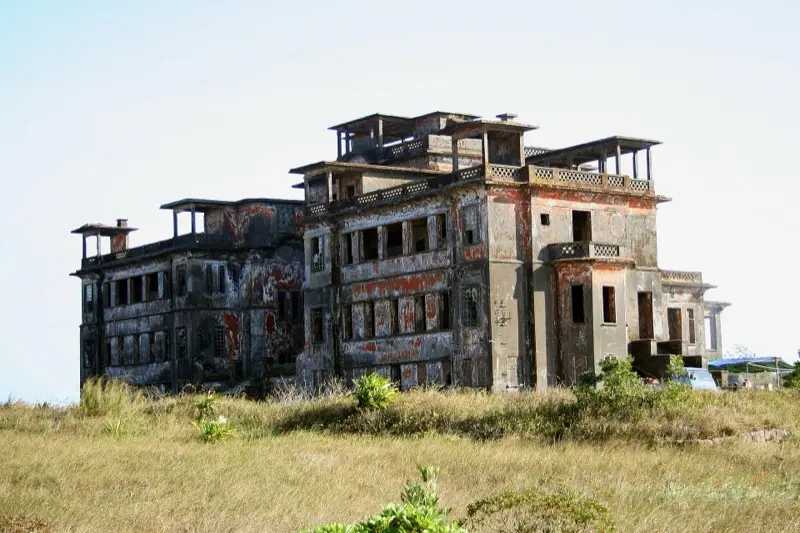
- Old Kep. Kep-sur-Mer was founded in 1908 as a seaside resort; its modernist villas were built between 1953 and 1970. Some are restored, others stand as shells.
- The view. On a clear day the long shape of Phu Quoc, an island belonging to Vietnam, sits on the horizon.
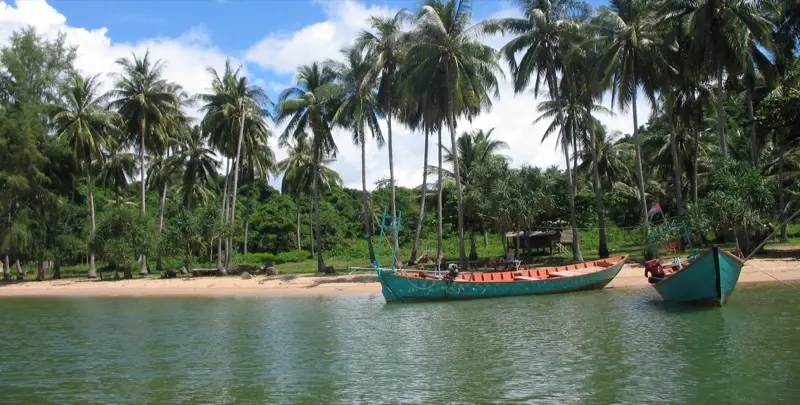
- Rabbit Island. Boats leave from Kep for Koh Tonsay, about 20 minutes offshore. It's a day in itself; see Rabbit Island from Kampot.
Ride with Seth
Seth's Kampot & Kep Full Day puts the crab market at lunchtime, after the Kampot countryside in the morning, with time by the sea afterwards. He knows where locals eat. Seth was born in Kampot and has guided for 12 years. Message Seth for a fixed quote on WhatsApp.
FAQ
How much is crab at the Kep crab market?
It changes with the catch and the season. A meal for two with a kilo of crab, some shrimp or squid, rice and drinks typically comes to about $20–30 in 2026. Always agree the full price, cooking included, before ordering.
What are the Kep crab market's opening hours?
There are no posted hours. Lunch is the main sitting and the liveliest time; if you're planning an evening visit, check locally first.
What is Kep's famous crab dish?
Crab stir-fried with fresh green Kampot pepper. Boiled crab with a lime, salt and pepper dip is the simpler alternative.
Do I have to bargain?
Only at the stalls, and only a little; the difference is usually a dollar or two a kilo. If you'd rather not, eat at one of the restaurants beside the market.
How far is the Kep crab market from Kampot?
About 25 km, or 35–45 minutes by tuk-tuk.