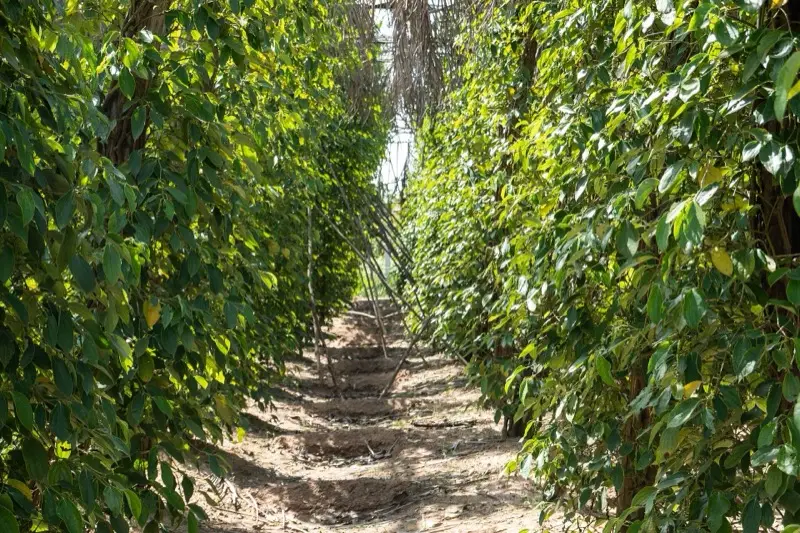
Secret Lake is not a natural lake. Known in Khmer as Tomnup Tek Krolar, it is an irrigation reservoir dug by forced labour under the Khmer Rouge in the late 1970s. Today it's a calm sheet of water among rice fields and pepper farms, right next to La Plantation, with no entry fee. Without its story it's just a pretty lake; with the story, it is one of the most meaningful stops in the Kampot countryside. Here is that story, told with only what we can verify, and how to visit with respect.
On this page
What and where Secret Lake is
The lake lies in the countryside between Kampot and Kep, off the main road and right beside the La Plantation pepper farm. By tuk-tuk it takes roughly 30 to 45 minutes from Kampot town, depending on the route and where you stop on the way.
It goes by several names, which confuses people:
- Tomnup Tek Krolar (also written Boeung Tanop Tek Krolar) is the local name. Tomnup means a dam or embankment, and boeung means lake.
- Brateak Krola Lake is the name you'll find on Google Maps and some trip planners.
- Secret Lake is the English nickname used by guides and tour operators.
Don't mix it up with Teuk Chhou (the rapids north of Kampot) or the Stung Pae reservoir, which have their own, separate stories.
The history: what we know
The Khmer Rouge took Phnom Penh on 17 April 1975 and ruled Cambodia until January 1979. In those years they emptied the cities, abolished money, markets and schools, and forced almost the whole population into rural work cooperatives. The regime wanted rice production raised fast, and set targets such as three tonnes of rice per hectare. To get there, people were made to dig dams, dykes and canals by hand across the country.
The work was brutal. People laboured from dawn into the night on starvation rations, with few or no rest days, and anyone judged lazy or disloyal could be punished or killed. Many of the irrigation schemes were badly engineered and never worked as planned. Across Cambodia, an estimated 1.5 to 2 million people died from execution, starvation, overwork and untreated disease in less than four years.
Secret Lake is one of these works. It was dug in the late 1970s as an irrigation reservoir for the surrounding rice paddies, by villagers from the area who were compelled to work under extremely harsh conditions. That is what the sources agree on.
Many families in Kampot lost people in those years. For older Cambodians this is living memory, not distant history.
What we don't know, and why we don't repeat it
You will find specific numbers online: a build time of a few months, a precise count of workers who died. These come from a single unverified source, so we don't repeat them. Some guidebooks also say the lake is thought to lie over a mass grave. We have found no documentation that confirms this for this lake, so we don't present it as fact either.
Records for individual reservoirs like this one are thin. Researchers have documented the Khmer Rouge irrigation campaign in detail, but many local sites were never formally studied. If you hear a dramatic figure from anyone, including a guide, it's fair to ask where it comes from.
What you see today
The lake is wide and quiet. Rice fields and pepper farms surround it, with limestone hills on the horizon. Water lilies grow in the shallows, and the trunks of drowned trees stand in the water. Visitors usually describe it as peaceful, and it is, which makes knowing the history all the more striking.
The lake changes a lot with the seasons:
| Months | What to expect |
|---|---|
| October–November | Fullest, at the end of the rainy season. Big reflections, green fields all around. |
| December–April | Dry season. The water slowly drops, and more dead tree trunks show above the surface. |
| May–September | Rainy season. The level rises again; afternoon showers are common, so mornings are safer. |
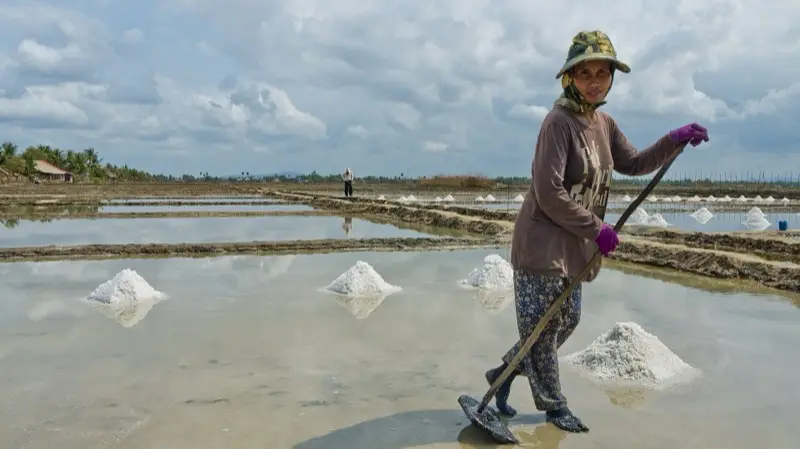
Late afternoon is the best time of day: the light is soft and the heat has eased. It also fits neatly before the salt fields at sunset.
How to get there
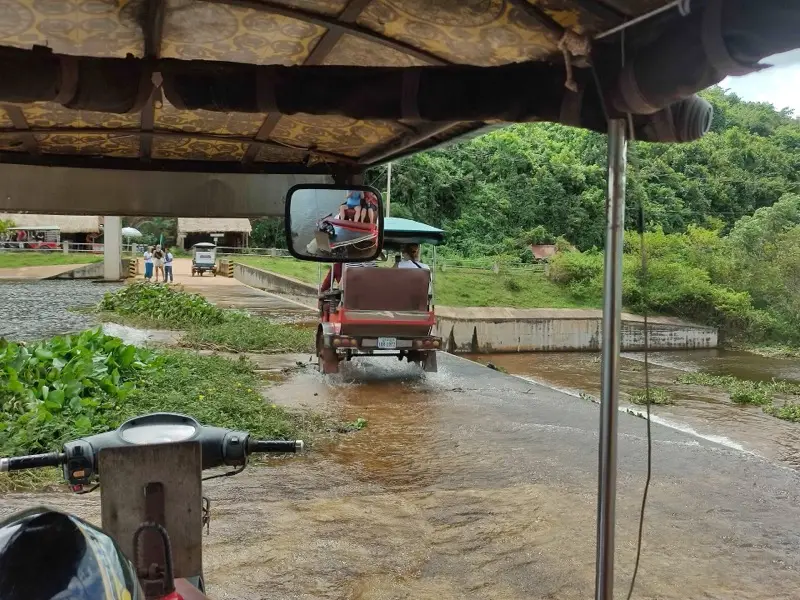
- By tuk-tuk: the usual way. Most drivers combine it with La Plantation next door, which closes its last visit at 4pm, so the lake often comes straight after the farm. The last stretch is on rural roads.
- By scooter: possible on your own; search for Brateak Krola Lake in your map app. You'll miss the story unless you've read up first.
- By kayak: Discovery Center, based at Kep West, runs kayak trips on the lake among the drowned trees. Check with them for current prices and times.
There is no entry fee that we know of. Allow 20 to 30 minutes for a walk and a look, longer if you want to sit with it.
Is Secret Lake worth it?
Honestly: as scenery alone, it's pleasant rather than spectacular. If you're only after views, Bokor or the Kep coast will impress you more. But it costs nothing, it's next door to La Plantation, and it is one of the few places near Kampot where you can stand in front of something the Khmer Rouge made people build. It's the stop where Kampot's recent past stops being abstract.
It's worth it if you'll hear the story there, from a guide or from this page. It's less worth a special trip on its own.
Etiquette: how to visit respectfully
- Keep it calm. It isn't a formal memorial, but treat it like one: no loud music, no party drinks on the bank.
- Think about your photos. Landscape shots are fine. Jokey poses don't fit this place.
- Ask before photographing people. Farmers live and work around the lake.
- Don't press people for their stories. Many older Cambodians lived through these years. If someone wants to share, listen; if not, don't push.
- Take your rubbish with you.
- Swimming: we can't confirm it's safe or permitted, so we'd skip it.
If you want to learn more
In Phnom Penh, the Tuol Sleng Genocide Museum (the former S-21 prison) and the Choeung Ek memorial explain the Khmer Rouge years in depth. The Documentation Center of Cambodia (DC-Cam) has spent decades collecting records and survivor testimony. In 2018 the UN-backed Khmer Rouge tribunal convicted the regime's two most senior surviving leaders, Nuon Chea and Khieu Samphan, of genocide and crimes against humanity.
Near Secret Lake, the day usually continues with La Plantation pepper farm, the Kampot salt fields and the Phnom Chhngok cave temple. Our Kampot countryside guide shows how to fit them into one day.
Ride with Seth
Seth was born in Kampot and has guided for 12 years, and he tells the Secret Lake story himself. The lake is part of his Kampot Countryside Tour; on the afternoon version you reach it in the late light, straight after La Plantation. If history is your main interest, ask about a custom day built around it. Message Seth for a fixed quote on WhatsApp.
FAQ
Why is it called Secret Lake?
It's an English nickname; the Khmer name is Tomnup Tek Krolar. As one guidebook puts it, the lake isn't really secret, but its history is easy to miss if nobody tells you.
Is Brateak Krola Lake the same as Secret Lake?
Yes. Brateak Krola Lake is the name Google Maps uses for Secret Lake (Tomnup Tek Krolar), next to La Plantation.
Who built Secret Lake?
Local villagers, under forced labour, during the Khmer Rouge regime in the late 1970s. It was dug as an irrigation reservoir for the rice paddies around it.
Is there an entrance fee?
No fee that we know of in 2026. If you kayak with Discovery Center, that's a paid trip.
How long do you need there?
20 to 30 minutes is enough for most people. It pairs naturally with La Plantation, which is right next door.