Kep is Kampot's seaside neighbour: about 25 km away, 35–45 minutes by tuk-tuk and around $8–12 one way. You can treat it as a simple transfer, but the road passes salt fields and pepper country, and Kep's crab market is the best-known lunch on this coast, so most people make a day of it. Here's how to do it well.
On this page
Distance, time and the road
By road, Kep is roughly 25 km from Kampot town, and the boundary of Kep province is only about 20 km out. A tuk-tuk takes 35–45 minutes each way on a flat road through rice fields, villages and, a few kilometres out of Kampot, the salt pans.
How much does it cost?
| Option | Typical price (2026) | Good to know |
|---|---|---|
| Tuk-tuk, one way | $8–12 per tuk-tuk | Agree the price before you leave |
| Tuk-tuk, return with waiting | $20–25 per tuk-tuk | Driver waits while you eat and walk |
| Private tuk-tuk, full day with countryside stops | Roughly $30–50 per tuk-tuk | Salt fields, pepper farm, Secret Lake, then Kep |
| Shared full-day tour | $20–27 per person | Fixed route and group |
| Bus | About $3 per person | Cheapest, but no stops |
| Motorbike taxi | $2–3 | One passenger, light bags |
| Rented scooter | From about $5 a day | You ride, you navigate |
Tuk-tuk prices are per vehicle, and a tuk-tuk usually takes up to four people, so for a couple or a family the private option often costs less per head than it first looks. PassApp, the cash ride-hailing app, works in Kampot for tuk-tuks and is a useful price check. For a full breakdown of fares around Kampot, see how much is a tuk-tuk in Kampot.
What to see on the way
The salt fields
A few kilometres out of town, flat pans of seawater stretch towards the coast. Around 200 families work the salt in Kampot and Kep. The harvest runs roughly from January to April or May, busiest in March and April, and the best moment is late afternoon, when workers carry baskets of salt along the dykes in soft light. So if you're making a day of it, stop here on the way back rather than on the way out. From about May to November the pans are flooded or idle; they're still worth a quick photo stop, but there's no harvest to watch. There's no fee. Ask before walking on the dykes or photographing anyone.
La Plantation and Secret Lake
Out in the countryside between Kampot and Kep is La Plantation, the best-known Kampot pepper farm. It's open daily from 9am to 6pm (last visit 4pm), with a small entry fee of about $2.50 issued as a voucher you can spend at the farm. From October to March you need to book a visiting slot online in advance. Next door is Secret Lake, a reservoir dug by forced labour under the Khmer Rouge: quiet and beautiful, with a heavy story. Both are covered in detail in our Kampot countryside guide.
Phnom Chhngok cave temple
This 7th-century brick temple, built inside a limestone cave, lies northeast of Kampot rather than on the Kep road, but it fits easily into a full day if you start early. Expect about 200 steps, a fee of about $1–2 and roughly an hour there.
In Kep
The crab market: how to order
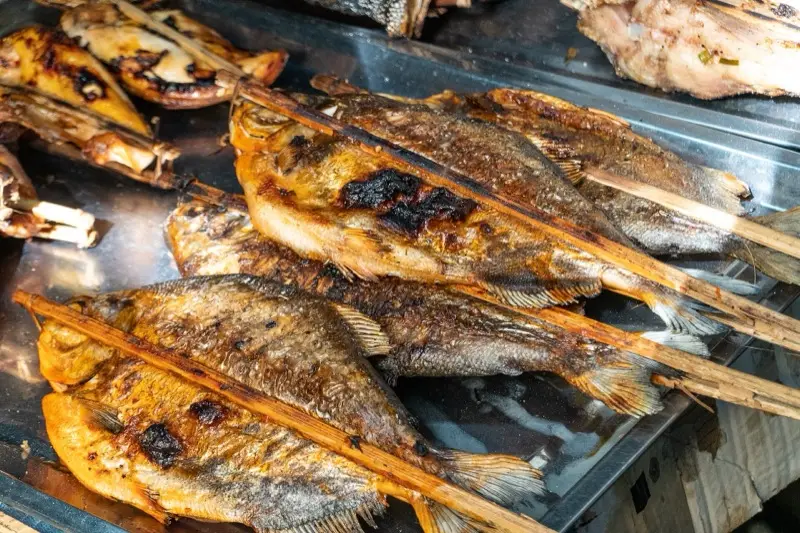
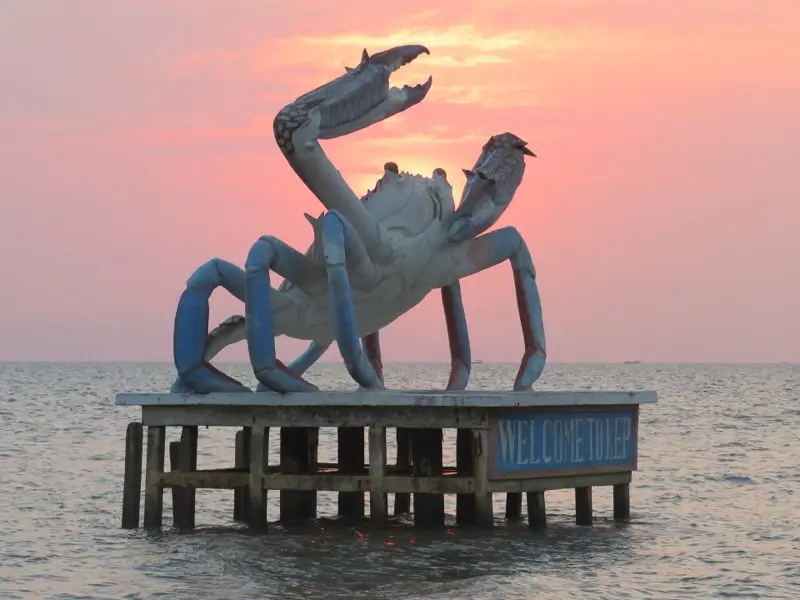
Kep's crab market is the reason many people come. Crab is sold live, by the kilo, and a stall or restaurant cooks it for you. The local classic is crab fried with fresh green Kampot pepper. Here's how to avoid an unpleasant surprise at the end:
- Look around first. Walk the stalls, see what's fresh and get a feel for prices before you commit.
- Choose what you want cooked: crab, and shrimp or squid if you like, plus rice and drinks.
- Agree the complete price before ordering. Ask what the total will be for everything, cooking included. Per-kilo prices change with the catch and the season, so don't rely on old blog prices.
- Budget about $20–30 for two. That's a typical 2026 bill for a kilo of crab plus shrimp or squid, rice and drinks.
Lunchtime is the natural moment to eat. Bring cash in small notes.
Beyond the crab
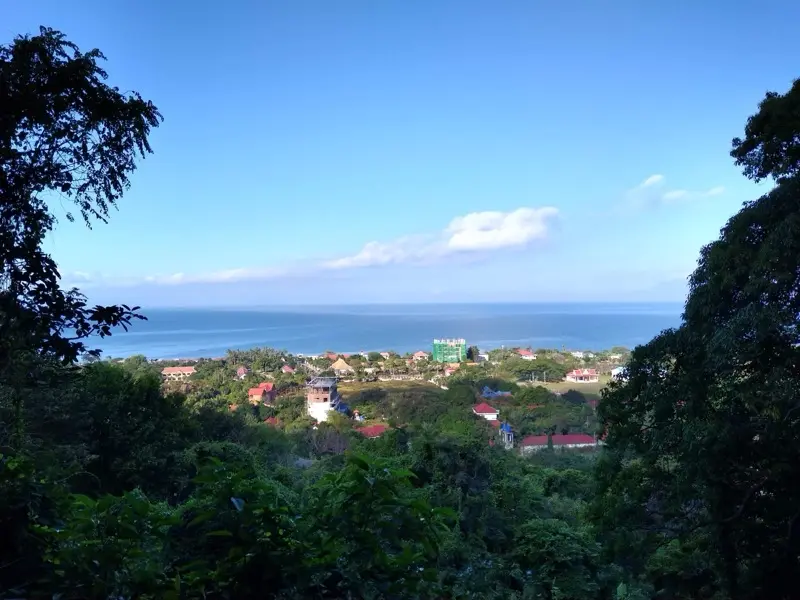
- The seafront. On a clear day you can see the long shape of Phu Quoc, an island that belongs to Vietnam, on the horizon.
- Old Kep. "Kep-sur-Mer" was founded in 1908 as a seaside resort, and its modernist villas date from 1953 to 1970. Some have been restored; others still stand empty.
- Kep National Park. An 8 km loop starts behind Veranda Natural Resort; most of the main track is now a concrete path. A steeper side trail, the "Stairway to Heaven", climbs past a small pagoda to Sunset Rock. Foreigners pay about $1 (4,000 riel) at the entrance or to a ranger on the trail. On a day trip, a short section is usually enough.
- Rabbit Island (Koh Tonsay). About 20 minutes offshore by boat. Shared boats have generally cost around $8–10 return, leaving in the morning and coming back mid-afternoon, but check the current schedule at the pier. It doesn't combine well with a tuk-tuk day from Kampot; plan it as a separate day or stay a night in Kep.
Making it a day trip
Here's a relaxed full day that gets the timing right for each stop. Adjust to taste.
- 8:00 Pickup in Kampot. Optional early visit to Phnom Chhngok while the steps are still cool.
- Mid-morning: La Plantation for the farm tour and tasting (with a booked slot from October to March), then Secret Lake next door.
- Around 12:30: Crab lunch at the Kep crab market.
- Early afternoon: The seafront, a short stretch of the national park trail, or simply a long lunch.
- Late afternoon: The salt fields on the way back, when the light is best and, in season, the workers are out.
- Around 17:00: Back in Kampot.
That's seven to eight hours and close to what most full-day tours offer. If you're staying overnight in Kep instead, a one-way tuk-tuk with a couple of stops on the way is a nice way to arrive.
Tuk-tuk, scooter or bus? The bus is cheapest but goes straight there. A scooter gives you freedom, but you're riding in the midday sun on a main road, and you need to know where you're going. A tuk-tuk is shaded, lets you stop wherever you like, and with a good driver you get the stories behind what you're seeing.
Ride with Seth
This is close to the day Seth runs as his Kampot & Kep Full Day: the countryside stops, crab in Kep at lunch and time by the sea, in a private tuk-tuk at your pace. In harvest season, ask him to keep the salt fields for the late-afternoon light. He was born in Kampot, has guided for 12 years and is rated 5.0 on Tripadvisor from 19 reviews. If you'd rather keep it short, ask him about the countryside half day or a simple ride down to Kep. Staying in Kep? Tell him where, and he'll say whether pickup there works. Message Seth for a fixed quote on WhatsApp at +855 96 694 6137.
FAQ
How far is Kep from Kampot?
About 25 km by road, or 35–45 minutes by tuk-tuk on a flat, easy road.
How much is a tuk-tuk from Kampot to Kep?
Around $8–12 one way, or $20–25 for a return trip with the driver waiting, per tuk-tuk rather than per person. A full day with countryside stops is roughly $30–50 for a private tuk-tuk.
Can you do Kampot and Kep in one day?
Yes. A full day of seven to eight hours covers the salt fields, a pepper farm, Secret Lake, the crab market and some time by the sea. Add Phnom Chhngok if you start early.
Should I stay in Kampot or Kep?
Kampot has the river, more places to eat and sleep, and is the base for Bokor. Kep is smaller, quieter and by the sea. Many people stay in Kampot and visit Kep for the day.